THE FLICKERING
LEXICON
A list of incorrect things
Dannyno’s
Concordance to the Song Lyrics of The Fall
Looking for Annotating The Fall, a successor to the legendary Annotated Fall?
Go
here: https://annotatedfall.thebiggestlibraryyet.org.uk/
THE CONCORDANCE
Abbreviated
words, beginning with ‘ or -
‘This work has not yet
reached cessation’
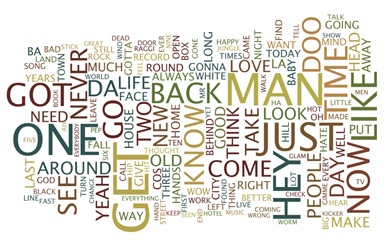
Credit: www.wordle.net, based on
words in Fall songs. Common
English words omitted
RESOURCES AND OUTPUTS
|
Thematic
Analysis (i.e. lists of
words by subject) |
|
||
INTRODUCTION and METHODOLOGY
Welcome
to The Flickering Lexicon,
a valiant but flawed – doomed, even – attempt to construct a
concordance to the song lyrics of The Fall.
Wikipedia defines a concordance
as
“an alphabetical list
of the principal words used in a book or body of work,
with their immediate contexts.” Concordances are a
widely-used tool in linguistics, allowing researchers to
compare uses of a word, study word frequencies, and so on. I
claim no relevant academic credentials myself, but there is
no reason why The Flickering Lexicon could not be pressed
into scholarly service. However, I imagine my main audience
is probably going to be fellow Fall
obsessives.
Fall
fans love lists (except for the Fall
fans who really really hate lists), and concordances are
great for list-makers.
The Fall Online Forum (FOF) has a large number of
threads devoted to listing things found in
Fall songs, all of which would benefit from
the use of a concordance (unless you’re of the camp which
holds that making life easier and more accurate is contrary
to the spirit of The Fall).
Years ago, Graham Coleman wrote an article for the September 1996
(#7) issue of the fanzine The Biggest Library Yet
(1994-2000), listing “Famous Names” which appear in Fall songs. And the heroically detailed
Martin Peters wrote a series of articles for The
Pseud Mag, analysing Fall lyrics from
different angles: “Humour in The Fall” (#1 Dec-Jan 2004/5);
“The Time of the Fall” (temporal language and dates, #2
February 2005); “The Insekt World of The Fall” (#3 April-May
2005); “The Medical” (health/body-related language, #4
Aug/Sept 2005); and “Words of Expectation: verbs used by
Mark E Smith in Fall Songs” (#8, Feb/Mar 2006, p.38).
Given
this tendency, it’s not surprising that the idea that
someone should produce a concordance is not a new one. FOF
member Glenselvy commented on 9 December 2003
that the Fall website was “the
biggest library yet” – and that therefore “the Library needs
Librarians”. Glenselvy then floated the
idea of “a concordance to The Fall. Or summat.”
[sic]. On 17 December
2009, FOF member delmore
posted that he was “working on a Fall lyrics concordance.” But there
was no progress on the concordance front until FOF member
(and creator of the original “The Annotated Fall”
[archived] site) bzfgt said on 16 August 2013,
“What I really wish someone would do is a Fall concordance, but I don’t think
I’m the man for the job.”
I responded on 20 August with,
“I’ve long thought of doing a concordance. I have the
necessary mania but not, unfortuanately
[sic], the necessary time…”
But the idea wouldn’t go away, and so mania
over-ruled lack-of-time and by 24 September
I had produced a first attempt.
In
October 2014, my attention was drawn by a fellow FOF member
to the work of Dr Matt Davies of the University
of Chester. It seems he has a
research interest in the lyrics of Mark E Smith, and in July
2009 he presented at the International Conference of the
Poetics and Linguistics Association (PALA) at Roosevelt
Academy, Middleburg, Netherlands, on the subject “The
Wonderful and Frightening World of WMatrix
and the lyrics of Mark E Smith”. He spoke about his
work at the 2014 Louder Than
Words
festival in Manchester, and was kind enough to mention The
Flickering Lexicon.
There
are already some song-lyric concordances out there. A Beatles
concordance entitled “Things We Said Today” was published in 1980 (it was
apparently the first time that pop/rock song lyrics had been
given the concordance treatment), and a Bob Dylan concordance
appeared in 1992. Web-based
lyric concordances include one for The Grateful Dead.
There aren’t many others.
Having now done one for The Fall, I understand why.
Before
the computer era, constructing a concordance was a
horrendously laborious and time-consuming task, which is why
the earliest concordances were produced for religious texts
and the works of Shakespeare and classical writers: one of
the most famous concordances is Cruden’s Concordance to
the Bible, first published in 1737 after two years’ work.
Access to computers has democratised concordance production,
at least in principle, and there are several software
products (freeware and paid-for) which can be downloaded and
used with relative ease.
Frankly, however, the process is still a complete
pig; just not a pig that drags on for years and years.
Colin
Campbell
and Allan Murphy, the compilers of the invaluable Things We Said Today
(usually referred to here as Campbell/Murphy), first had the
idea of producing a Beatles concordance in 1976 – it took
them four years from conception to publication, working
thousands of miles apart in an era before email. They used
punch-cards and a room-filling IBM system 370 model 155
mainframe with three megabytes of memory. Their book also
contains definitive versions of all the Beatles’ songs (184
distinct songs, plus variants and minus exclusions, making a
final total of 189), for each of which they had to obtain
reprint permission – itself a laborious business. To put their
achievement and my whining into perspective, it only took me
a matter of months to produce an experimental first draft of
my concordance, initially using the free Simple Concordance Program
(v.4.09) on my laptop – which has 8 GB of RAM. So I have no right
to complain.
It
is of course foolhardy to set out to construct a concordance
of the lyrics of a group who have not actually stopped
writing songs (unless you’re picking a selection of songs
representing a particular time period, perhaps). The attempt is
particularly misguided when the group in question is The
Fall, whose vocalist and main lyricist Mark E Smith is one
of the most difficult
in rock music. Although
Smith’s lyrics can sometimes be clear and simple, they are
often obscure or indecipherable. Furthermore, the usual
pre-requisite for compiling a concordance is access to
definitive texts. Unfortunately, there is no consistently credible
(see “Acknowledgements” below) definitive edition of Fall lyrics, even those which are
Smith-approved.
Smith
himself
has undermined the very notion of a “definitive text”,
telling Mick Middles: “To me, a song’s never finished and
it’s never good enough, that’s why I don’t write lyrics
down. Once they’re on paper, you can’t change ‘em, and I
like to change ‘em, even just before
I’m going on stage. I am changing lyrics all the time. They
are completely fluid. I can change and scribble and then
change my mind, try it out at some gig in fucking Doncaster
and, if I don’t like it, change it. Lyrics change shape and
meaning all the time.” (Smith and Middles, pp.271-272).
So
the sensible concordance-compiler would not touch this
project with a barge-pole.
And yet, there is perhaps something Fall-like about
the ludicrously obsessive, worse-than-Sisyphean task I have
set myself. Or
perhaps I am just an idiot. It’s a thin line.
There
will be those who would question the point of The Flickering
Lexicon. Campbell
and Murphy remark (p.xi) that
“The value of such an analysis seemed self-evident to us”, a
sentiment I endorse. This kind of thing interests me, and I
don’t really care if it doesn’t interest anyone else. However, lyrical
analysis, interpretation and archaeology has provoked fierce
arguments on The Fall Online Forum. Some fans believe that
The Fall resists such analysis, but that doesn’t seem to be
an argument against
analysis, just a further provocation to analysts. In fact, I
find the resistance
part of what is interesting about Fall
lyrics in the first place.
Mick
Middles, for example, has written: “People scrutinise Fall lyrics and spin deeper and
deeper into literary theory. Which is to miss the point…
Better just to accept The Fall for what they are. And
enjoy.” (Smith and Middles, p.278). But who gets to
decide what “the point” of The Fall is for any particular
listener? Surely
that’s something that cannot be imposed by a critic or even
the artist themselves.
And if we are to “accept The Fall for what they are”,
we have first to have some understanding or notion of what
The Fall are, which invites the scrutiny Middles (along with
MES, sometimes) resists.
In fact, Mark E Smith told Middles, “When I started
buying records, the ones I liked were the ones I could only
half-understand. What
I don’t like about a lot of records today is that they’re
too clear. There’s no fascination or mystery left.” (Smith
and Middles, p.278). Smith is surely here expecting attention from his
audience. He is giving his fans something they can engage
with, not something they should just blankly consume without
curiosity. Mystery
inspires investigation, not indifference. What else can
“fascination” with lyrics mean than to find those lyrics
interesting and/or important and to become engrossed in them
and want to understand them better?
Below
I explain what I’ve done and how I’ve gone about doing it,
and set out the reasoning behind my editorial decisions
(where, that is, they haven’t been entirely arbitrary). But first, a
comparative statistical overview.
Comparative Statistical Overview
This
concordance to the lyrics of The Fall is based on a corpus
of the texts of 493 songs (or significant variations of
songs) released between 1976 and June 2014. There are 99,124
words (known in linguistics as ‘tokens’) in the corpus, of
which 9609 are unique words (known as “types”, which I will
refer to as the ‘vocabulary’ – note that I am including
years, times and numbers as ‘vocabulary’). The type/token
ratio (9609/99,124) is 0.0969. The size of the vocabulary is
about 9.7% of the size of the corpus: or to put it another
way, each word is used – taking the arithmetic mean as the
average – about ten times.
However, of the 9609 vocabulary words, about 47.4%
(4557) are used only once and 86.9% are used less than the
average. Just 127 vocabulary words (or 1.3%) account for
about half the 99,124 words in the complete corpus.
Campbell
and
Murphy’s Beatles concordance, Things We Said Today
(1980) was based on 189 songs recorded between 1962 and
1970. The corpus size was 35,390 words, and the vocabulary
size was 2346 unique words (i.e. 6.6% of corpus size, or
each word used on average about 15 times). The type/token
ratio is 0.0663. 935 of the vocabulary words are used only
once (39.85%).
According
to
Leech, Rayson and Wilson’s Word Frequencies in
Written and Spoken English (2001), based on the
British National Corpus, 52.44% of word forms occur only
once in the BNC.
http://www.oxforddictionaries.com/words/the-oec-facts-about-the-language,
looking at the Oxford English Corpus and referring to lemmas
rather than unique words per se (a lemma is the base form of
a word, i.e. falling,
fell, fallen, fall and falls are all
examples of the lemma fall) tells us that 100
lemmas account for over 50% of the corpus and just 10
account for 25%.
More
statistical discussion and comparisons can be found here.
Defining the scope of The Flickering Lexicon
The
most important decision I had to make was what to include in
the corpus on which The Flickering Lexicon would be based,
and what to exclude. This
might sound like it would be a straightforward thing to
decide, but it wasn’t.
First of all, I spent some time thinking about
whether The Flickering Lexicon would be a concordance to
lyrics of songs by The Fall, or a concordance to the
complete works of Mark E Smith. In plumping for
the former, I put a lot of weight on the practical
consideration that it would be much easier to restrict the
concordance to Fall song lyrics: most of them have already
been transcribed and published in various formats. Whereas on the
other hand, Smith’s writing encompasses formats other than
lyrics: memoirs, short stories, spoken-word/electronica solo
projects, lyrics for collaborative musical projects, plays
and more. Much of it is not easily obtainable in electronic
format. It would not be practically possible to include
everything which should in principle be included, which
would make it a pointless undertaking. Furthermore, Fall songs are a distinct and
distinctive body of work. Despite the many musicians and
non-musicians who have passed through the ranks of the
group, there is an aesthetic congruity to the songs and
lyrics which legitimises the narrower focus. However, the logic
of this position also leads to a wider remit than might
perhaps be expected, and leaves some puzzles to resolve.
To
summarise: the objective of the The Flickering Lexicon
project is to construct and maintain a concordance to the
lyrics of songs by The Fall.
Is it obvious what “songs by The Fall” means? No, it’s not. My
remit uncontroversially excludes Smith’s
work with other artists (the Von Südenfed
collaboration, for example, is out of scope), assorted poems
(“Wigan Soul Poem” from The Fall Lyrics, “Village Bug” from
Sinister Times, “Yeller Mania” (uncredited, but likely the
work of MES) from the cover of the c.r.e.e.p.
single), the contents of Smith’s two “solo” records (The Post Nearly Man,
1998; Pander! Panda!
Panzer!, 2002), “Hark the Hoaly
Lunatic”
(printed in the NME 21-28 December 1985, p.15), “Musical
Influence in Great Britain on Big-Head Here” (from the 1994
anthology “Idle Worship”,
edited by Chris Roberts), and the short story “No Place Like It” (MES’s contribution to the 1999
Penguin anthology “The City Life Book of Manchester Short
Stories”). But
how should I treat lyrics that Mark E Smith did not write or
does not sing? Campbell/Murphy
included “all the songs written, recorded and released by
The Beatles as a group between 1962 and 1970”, but excluded
“songs which The Beatles recorded but did not write or songs
which they wrote for other performers” as well as bootleg
recordings and studio out-takes (p.xv).
In
the end I decided to err on the side of inclusivity: cover versions and
lyrics written or sung by group members other than Smith
were included,
the important thing being that the songs are under the
rubric of The Fall.
I think this follows logically from my decision not
to produce a Mark E Smith concordance, but it’s a decision
that has consequences which require some discussion. Cover
versions have been an important part of The Fall’s
repertoire, but there are no doubt those who, buying into
the idea that The Fall basically reduces to the artistic
vision of Mark E Smith, will claim it is perverse to include
lyrics to songs performed by The Fall but not written by
Mark E Smith, but to exclude lyrics to songs written or
co-written by Mark E Smith but not performed by The Fall. But I think it is
reasonable to say that The Fall as a unit is what will
interest most users of the Concordance, and that the group
should not be seen as merely one among many outlets for
whatever it is that Mark E Smith thinks he is doing. It’s also worth
noting that Fall cover versions
do often differ from the originals, musically and lyrically.
The lyrics to The Fall’s version of The Kinks’ Victoria, for
example, has three verses to the original’s four, and with
unexpected decorum renders the line “Sex was bad, called
obscene” as “It was bad, called obscene”. The Fall’s cover of Ghost in My House
alters a reference to a “coffee cup” to a “tea cup”, among
other changes.
In
chronological terms, coverage extends from the formation of
the group in 1976 to the release of the track Fibre Book Troll on
the multi-artist compilation Modeselektion Volume 3 in June 2014: a total of 493
individual songs and song versions. Other songs which
have been played live or subsequently released on record
during 2014 or afterwards will be candidates for inclusion
in future editions of The Flickering Lexicon.
Having
settled,
at least to my own satisfaction, the issue of the scope of
the concordance, the next stage was to collect the texts of
the lyrics for processing.
Before I could do that, however, I first had to
create a canonical list of Fall
song titles to use as a checklist. I decided that in
principle the canonical list would include everything without
distinction: every song performed, recorded, rehearsed,
reported or reliably rumoured to have existed. All the
official studio output would be there, of course, but I
would also draw on live recordings (official, bootlegs and
fan-traded), videos/DVDs, Peel sessions, compilation
contributions, out-takes and remixes in order to pick up
significant alternate versions (i.e. not just different
performances, see “Assembling the Fall Lyrics Corpus” below)
and otherwise unrecorded material. I didn’t stop
there: I also
scoured books, fanzines and the web for evidence of songs
which remained unrecorded or otherwise unknown. If it was
attributed to The Fall, it went in.
For
the avoidance of doubt, Pearson’s Revenge,
a poem attributed to C. Ritchie on the Fall’s
Shift-Work and
Holidays DVD (1991), did not make it onto the
canonical list.
The
finalised canonical list was then divided into included and excluded songs. To be included, a
song obviously needed to have lyrics. Instrumentals were
therefore quickly excluded, but there are a few borderline
cases. Faced with a similar decision, Campbell/Murphy
excluded Revolution
Nine from their Beatles concordance, despite the fact
that it does feature vocals. I have treated Symbol of Mordgan
and Where’s the
F***in Taxi? C*nt?
as practically equivalent to
instrumentals, as they consist entirely of pre-recorded
dialogue. Also
excluded were songs of which no official recorded version
seems to exist (Classical
Gas, for example): there is no way of knowing, in such
cases and within the restrictions I have set myself, what
lyrics were sung. Race
Hatred is an exception because of the existence of a
lyrics sheet, and You
Don’t Turn Me On is included on the basis of Una Baines’ memory of what some of
the lyrics were. Cab Driver has
been excluded on the grounds that it is generally regarded
as an early version of City Dweller and
the lyrics are in any case very indistinct on the recorded
version that appears on the B-side of the Behind the Counter
single.
Assembling the Fall Lyrics Corpus
I
have treated original studio recordings as the preferred
canonical standard for lyrics, but have also allowed for
selected remixes, significant alternate versions and lyrics
sourced from official live recordings if nothing better
seems to exist. The
Concordance includes texts from two versions of the
following songs: Mere
Pseud Mag. Ed.; New
Puritan; Touch
Sensitive; Blindness;
Clasp Hands; Recovery Kit; Cosmos 7; Devolute. The
remixes included are: Last Nacht (remix of Bremen Nacht), and
League Moon Monkey Mix
(remix of The
League of Bald-Headed Men).
Should
albums be regarded as more definitive than singles? Should
precedence be determined chronologically? Basically I have
done whatever I felt like doing. For example, I
have used the Middle
Class Revolt album version of 15 Ways rather than
the slightly different single version or Mark Goodier session version, despite the
fact that the single preceded the album and the session
version has some interesting lyrical variations. I just think the
album version is better. The same consideration applies to 2 x 4.
A
list of all the Fall songs included can be found above, as
can a list of all the Fall songs that have been excluded –
usually because they are instrumentals, but sometimes
because no recorded version exists – or if it does, that the
vocals are distorted to destruction and/or unlistenability (I did try to
transcribe an early live version of Louie Louie, but
gave up – I may be obsessive, but I’m not a martyr).
Line arrangement
I
have imposed my own line arrangement on the texts, freely
disregarding any evidence from printed lyric sources. I took
a few factors into account: a) what looks best when printed
in the Concordance; b) what makes most sense according to
the rhyme scheme, if there is one; c) what it sounds like
the line arrangement might be. It is worth noting that MES
is typically not writing poetry, and so line arrangement is
perhaps not necessarily very important. Anyway, I’ve done
my best to make things look neat and tidy, but remember that
the source material is not remotely neat and tidy.
Orthography
British
English
spelling conventions have been adopted throughout. However, following
Campbell/Murphy I have used colloquial spellings whenever
that sounded appropriate (for example, “gonna”), as well as
abbreviated word forms. I have not typically tried to
represent MES’s speech patterns and accent through spelling,
nor have I adopted spellings which may have appeared in the
lyrics books or elsewhere. Another challenge was (real or
invented) foreign language vocabulary: I have partly relied
on others’ transcriptions, and partly done my best according
to what my ears were telling me. I’ve made my own
decisions about which words should be hyphenated, and tried
to be consistent in doing so.
Homographs
Homographs
are
words with different meanings but the same spelling. So for example the
word “cast” is used as a verb in Iceland (“Cast the runes
against your own soul”) and as a noun in Weather Report 2
(“The cast deserved to die”).
The current edition of The Flickering Lexicon makes
no attempt to distinguish between such different meanings.
Vocal Noises
Fall
songs are full of shrieks, screams, growls, “hup!”s,
“huh-uh-huh”s, and, most
notoriously, “-ah” or “-uh”s. The
“-ah”/”-uh” suffix is really an artefact of MES’s accent, and I find the
tendency of the media to laugh at it both patronising and
tedious; users of The Flickering Lexicon therefore won’t
find any examples here, with the lone exception of a couple
of instances from the song Ol’ Gang where it seems to serve a different
function. Leaving
“-ah”/”-uh” aside, it is not possible in most cases to
determine with any certainty whether exclamations, shouts
and vocalised noises are technically supposed to be words or
not. I have excluded wordless screaming, gargling and so
forth, but following Campbell/Murphy I have decided to
include some vocalisations as if they were words whenever I
felt they seemed significant, despite the problems inherent
in doing so. I have tried to apply standardised (often
onomatopoeic) spelling (for example, I used a consistent
spelling of “aarrgghh”
throughout the corpus), but frankly it’s all a bit dubious.
Backing Vocals
Some
Fall songs have straightforward
backing vocal parts. Sometimes
it isn’t clear which vocals are taking the lead, if any. Sometimes there
are several colliding vocal parts, and it is very difficult
to work out what is going on.
When it is tolerably clear what the backing vocal is,
I have put the lines in single brackets so they are
distinguishable in the Concordance. Otherwise I have
just muddled along as best I can.
Numbers, Dates and Times
Most
cardinal numbers (one, two, three etc.) and ordinal numbers
(first, second, third etc.) have been transcribed as words
and are therefore sorted alphabetically for concordance
purposes. For
convenience, I will create a separate list of them. However,
times (i.e. “9:30”) and years (i.e. “2001”) have been
transcribed numerically and have their own section in the
concordance. There
are a handful of other items which I have transcribed as
numbers: “18-30” as in Club 18-30, “45” and “45s” as in 45
RPM records, “555” as in the cigarette brand, and “59” as in
Blob 59. I
decided to transcribe what might otherwise appear as Roman
numerals as words. So for example, it is “I am Roman Totale
seventeen” (Second
Dark Age) rather than “I am Roman Totale XVII”, on the
grounds that that is how it is actually pronounced.
Mark-up
A corpus is more than just the text. In order to perform any analysis of the text, it needs marking up, to indicate the important features. This could include codes for parts of speech, or other linguistic features. For the purposes of The Flickering Lexicon, I have kept this simple and restricted the coding to song level. The corpus includes mark-up for the following information about each song:
· Title
· Year (usually first year of official release of the version I’ve used)
· Date (of official release of the version used)
· Code (an abbreviated form of the release title)
· Release Title
· Vocalist (the main vocalist or vocalists – future versions might try to mark up song texts to identify backing vocalists, or the precise lines sung by each main vocalist, and so on)
· Whether the song is by The Fall or is a cover version
· Format (album, single/EP, Peel session, Other radio session, Live, Other version)
In addition to possibilities recorded above, I will give consideration to including track timings and song part (i.e. chorus/verse/dialogue) in future editions of The Flickering Lexicon.
Stop Words
It is not uncommon to exclude certain very common words from concordances (“a”, “and” etc.). I have included everything.
Repeated Lines
The nature of song lyrics is that certain vocal lines are repeated – often dozens of times. Because I wanted to be true to the structure of the source text, I have decided to include every occurrence of every line. Obviously this approach means increased frequency for some words, for example those used as part of a repetitive chorus. Some users of The Flickering Lexicon may think that this will lead to distortion of statistical analysis, but I disagree.
Dialogue
In their released versions, several Fall songs include pre-recorded dialogue, announcements, radio broadcasts and other spoken word material which would not necessarily be performed live. I have usually decided to include the dialogue in the song texts I’m using. Here’s a list of the affected songs:
· God Box – introductory exchange between MES and Brix Smith.
· Mother-Sister! – introductory exchange: “What’s this song about?” “Er, nothing.”
· Lucifer Over Lancashire – introductory off-air recording of a radio phone-in, apparently involving Craig Scanlon.
· Australians in Europe – opening dialogue is a taped conversation between MES and Trevor Stuart.
· Rememberance R - includes a spoken word rant by Ding about bands reforming.
· Paintwork – includes an snippet of dialogue from an Open University broadcast, attributed to MES accidentally triggering the record button on his dictaphone/cassette recorder in his hotel room.
· Ivanhoe’s Two Pence – begins with some lines of dialogue taken from an Italian film entitled La spade normanna, dubbed into English (a version often titled, Ivanhoe, the Norman Swordsman).
· Jam Song – starts with a recording of one of the producers expressing the view that the song needed a chorus – he was sent home.
· I Wake Up In The City – includes an extract from an off-air recording of Kate Hoey (former UK Minister of Sport) talking about a requirement for schools to provide a minimum of two hours physical education per week.
· Assume – starts with some dialogue recorded from an unknown television programme.
But I haven’t been consistent. Here are some songs where the spoken word content has not been included in this edition of The Flickering Lexicon:
· Fortress – “And today, here on the vitamin B glandular show” omitted.
There are also some tracks which, as noted above, I have excluded from the concordance, because they consist wholly or mainly of pre-recorded material:
· Symbol of Mordgan – apparently a recording of Craig Scanlon being interviewed by John Peel about football.
·
Where’s the F***in Taxi? C*nt? –
MES, Ed Blaney and others talking,
drunkenly.
Lyrical Disputes and Controversies
As I have already indicated, the general lack of “definitive” MES-supplied lyric sheets means that Fall fans have usually had to rely on the evidence of their own ears when trying to decipher what is being sung. Inevitably, this leads to disputes and controversies, and in some cases the ensuing arguments have been long-running and intractable. For concordance purposes I have had to make decisions about how these controversies should be resolved, but obviously those decisions cannot and will not put an end to the arguments. I discuss what I regard as the most significant of these disputes below.
Guest Informant
Probably the most notorious Fall lyrics dispute, with no resolution in sight. The Fall Online Forum thread on the subject currently runs to 16 pages. The dispute concerns the chanted refrain which the Lyrics Parade [see here] rendered as “Baghdad/Space Cog/Analyst”. The Lyrics Parade used to include a note of explanation, but this is omitted from the current site. The note read:
Sean Russell advised on 14 February 1996: "I wrote to Cog
Sinister with a pile of questions, one of them being what the
hell Brix was saying [in "Guest Informant"]. Lucy [Rimmer] wrote back
and said she asked Brix, who said the phrase was
"Baghdad/Space Cog/Analyst" [Source: Annotated
Fall [archived]]
However, few listeners seem to agree with that.
Contraflow
Acknowledgements
This final first edition of this concordance
was based in the first instance on the lyrics as they evolved at
the ground-breaking Annotated Fall
site (sadly now deceased and now available only as a snapshot in
the Internet Archive), which in turn was based on the texts at
the wonderful and venerable The Fall Lyrics Parade,
originally compiled by Jonathan Kandell
and Jeff Curtis, and now edited by Conway Paton. I used Lyrics
Parade texts when songs were missing from The Annotated Fall
site (cover versions, principally but not exclusively). Those two sources were
supplemented by Fall Tracks A-Z,
part of the Reformation!
Fall-fan site. There are two books of Fall
lyrics, both published with Mark E Smith’s blessing. Typically, however,
they are not entirely reliable.
I have referred to them sometimes, but have not treated
them as canonical, as compared to the evidence of my own ears
(and the collective ears of Fall
fans as reflected in the fan-published lyrics sources).
With the Annotated
Fall now dead as a live project, I have launched a
successor at the new Annotating
The Fall lyrics website. Future editions of the
concordance will use the version of the lyrics to be found
there.
In constructing the Concordance, I have felt the need to make my own amendments to the texts I have used. Responsibility for what appears here therefore rests with me, as much as I might try to deny it later.
The final version of The Flickering Lexicon has been produced using Rob Watt’s Concordance Software. Watt is an Honorary Research Fellow in English at the University of Dundee.
Finally, I would like to pay tribute to the pioneering work of Campbell/Murphy: their book has been a useful source of guidance for my own project, but it is not responsible for my errors.
Bibliography
Campbell, Colin and Murphy, Allan (1980). Things we said today: the complete lyrics and a concordance to The Beatles’ songs, 1962-1970. Ann Arbor, MI: Pierian Press.
Griffiths, Dai (2003). From lyric to anti-lyric: analyzing the words in pop song. In Moore, Allan F. (ed.) (2003). Analyzing popular music. Cambridge: Cambridge University Press. Chapter 3, pp.39-59.
Mátyás, Csikós (2014). The change in the lexical complexity of Van Halen songs. Blog posting available at: http://wondefulworldofappling.blogspot.co.uk/2014/05/the-change-in-lexical-complexity-of-van.html (9 May 2014).
Fell, Michael and Sporleder, Caroline (2014). Lyrics-based analysis and classification of music. In Proceedings of COLING 2014, the 25th International Conference on Computational Linguistics: Technical Papers, pp.620–631, Dublin, Ireland, August 23-29 2014. http://www.aclweb.org/anthology/C14-1059
Khalifa, Jean-Charles (2007). A semantic and syntactic journey through the Dylan corpus. In Oral Tradition, Vol. 22 (1) pp.162-174. http://journal.oraltradition.org/files/articles/22i/Khalifa.pdf
Leech, Geoffrey; Rayson, Paul and Wilson, Andre (2001). Word frequencies in written and spoken English: based on the British National Corpus. Harlow: Pearson Education.
Schmidtke, Daniel (2013). Time out of mind: a corpus linguistic analysis of 50 years of Bob Dylan lyrics. Blog posting available at: http://danschmidtke.wordpress.com/2013/05/24/time-out-of-mind-a-corpus-linguistic-analysis-of-50-years-worth-of-bob-dylan-lyrics/ (24 May 2013).
Smith, Mark E and Middles, Mick (2008). The Fall. Updated edition. London: Omnibus Press.
Werner, Valentin (2012). Love is all around: a corpus-based study of pop lyrics. In Corpora, Vol. 7 (1), pp.19-50.
Beta version published September
2013.
First edition published October 2014
Latest Update: 6 June 2015